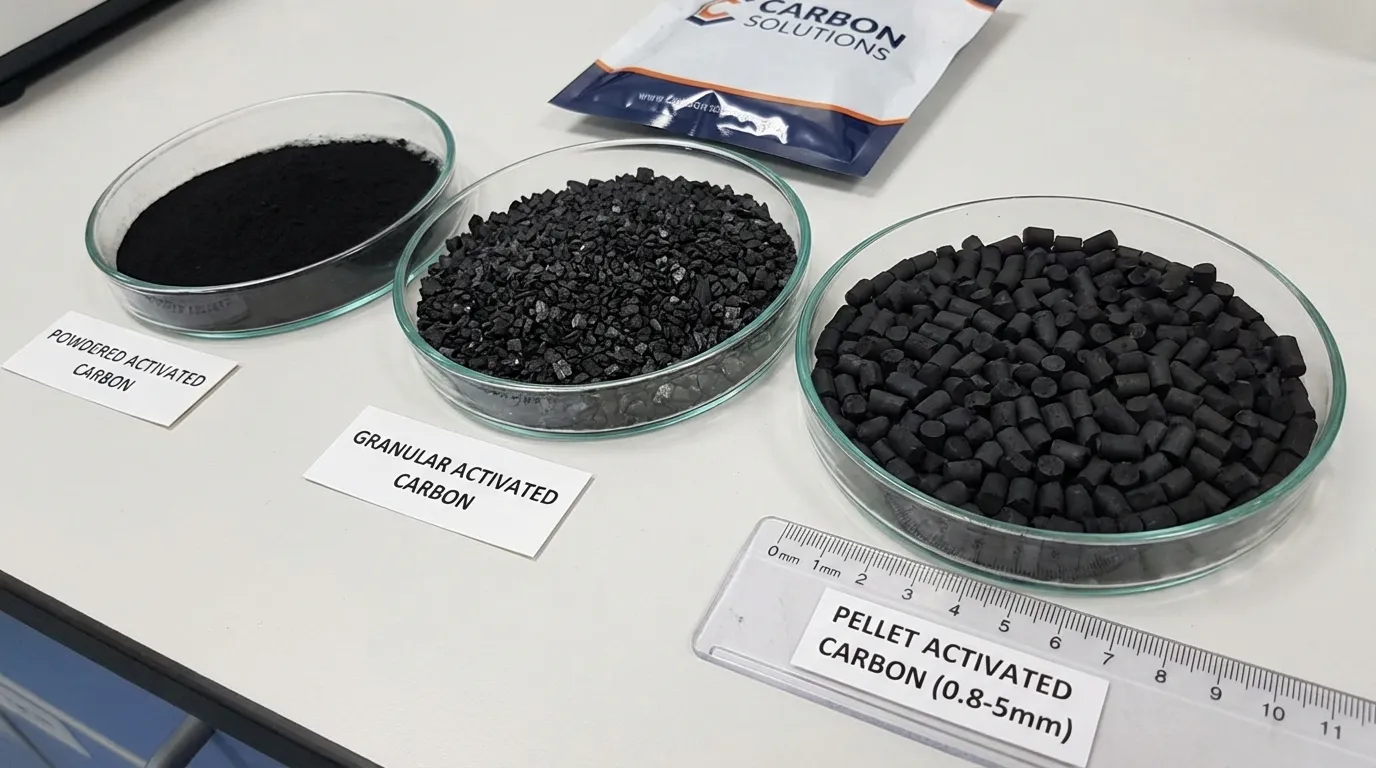
Activated carbon is available in two primary physical forms: granular activated carbon (GAC) and powdered activated carbon (PAC). Choosing the right form depends on your application, budget, and process requirements. Understanding the differences helps ensure optimal performance and cost efficiency.
Granular Activated Carbon (GAC)
GAC consists of irregularly shaped particles typically ranging from 0.2 to 5 mm in size. It is commonly used in fixed-bed adsorption columns for continuous water and air treatment. GAC offers the advantage of being reactivated and reused multiple times, which lowers long-term operating costs. Its larger particle size also results in lower pressure drop across filter beds, making it well suited for high-flow applications.
Powdered Activated Carbon (PAC)
PAC is milled to a fine powder with most particles smaller than 0.18 mm. Because of its high surface-area-to-volume ratio, PAC adsorbs contaminants more rapidly than GAC. It is typically dosed directly into water treatment processes and removed along with sludge. PAC works well for seasonal or intermittent contamination events where permanent filtration infrastructure is not justified.
Which One Should You Choose?
For continuous treatment with predictable contaminant loads, GAC in a fixed-bed system is generally more economical. For batch treatment, emergency response, or fluctuating water quality, PAC provides flexibility without major capital investment. Many facilities use both forms at different stages of their treatment process to balance speed and cost.
Interested in Our Products?
Leave us a message and we'll get back to you within 24 hours.